
Skip to content

    Food for thought

    Every Tandem dinner leaves something here: the 1:1 preparation conversation ahead of the gathering, the reflections and the questions we walked in with or that surfaced during the evening.

    We share some of what stays with us so we expand the conversation and raise the questions that matter. As we heard, "AI is philosophy on a deadline", so these questions matter immensely.

    Marine setting the table before a Tandem dinner
    Intro to our summer series

    This summer, we're taking a moment to appreciate this first season of Tandem before we see you again in the fall. Since December, we've hosted ten dinners across two cities, seven in Paris and three in Berlin, around our first three themes. Each evening brought together a different mix of researchers, entrepreneurs, practitioners and other fascinating profiles. The conversations that came out of them were exactly what we hoped for when we started this. To mark the season, we're sharing a recap of those first ten gatherings as a summer series, a chance to revisit the ideas, the rooms and the people who made them what they were. Thank you to everyone who pulled up a chair. There's more to come.

    Early September, we'll happily share a full recap of our series with the story of Tandem. Sign up to receive it.

    Warmly,
    Marine and Margaux

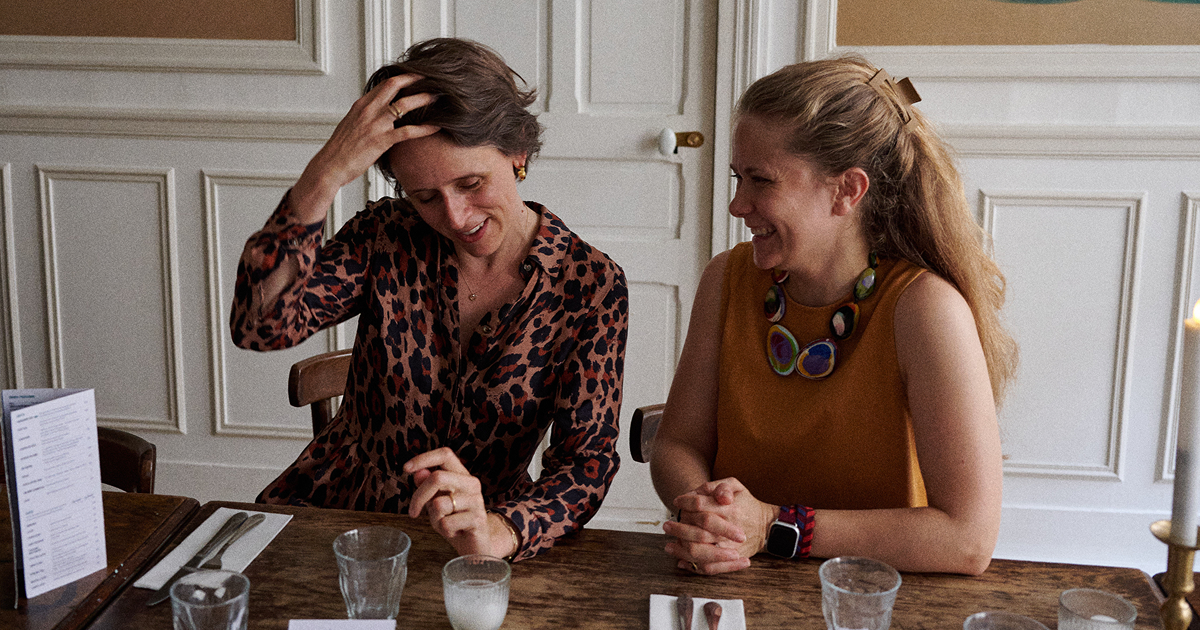
    Marine and Margaux at a Tandem dinner table
    Edition 1

    Agency and singularity: cultivating our humanity with AI

    Key Takeaways

    • 1. Intention must take precedence over the possible. The machine calculates, but direction and meaning remain a human gesture. The watchword is not to augment oneself, but to expand: preserve what connects us to the world and to others.
    • 2. Singularity becomes an imperative, not an obstacle. The more execution becomes commonplace, the more taste, intuition, and presence make the difference. The question shifts from "do you know how to do it?" toward "do you know what to do and why?".
    • 3. Stay "above the line" (of human-AI delegation). Competence is built through friction. Delegating a task is not delegating a learning: the real gesture consists of protecting the experiences that forge the craft and choosing what we do not entrust to the machine, in the name of what we carry.
    • 4. Access and the power of decision over delegation are the real questions. Who controls these tools? Who sets the rules? Who reaps the benefits? Our own advantage itself deserves to be questioned.
    • 5. A European path remains to be written. Several voices called for a more sensitive approach, more conscious of the human stakes, for a more embodied technological future.

    Reflections

    Since November 2022 and the instant success of ChatGPT (with 3.5) and its 100m users in 2 months, generative AI has been automating a growing share of our intellectual work: writing, analyzing, synthesizing, imagining. Faced with this rising power, one question imposes itself as the starting point of our first Tandem dinner: what, in our work, must remain deeply human and irreplaceable? Not by default but by conviction.
    The conceptual starting point is that of the "Company of One," formulated by Paul Jarvis in 2019 in his book of the same name. A professional practice built on autonomy, (human) agency, and simplicity. Paul Jarvis poses a simple question: how do you become more capable without becoming more complex? AI suddenly gives this ambition a new scale; a single well-equipped person can now rival an entire team, provided she remains in command of what she entrusts to the machine.
    This first theme therefore explores the intersection between generative artificial intelligence, singularity, and agency. We chose it for a first dinner in Paris, bringing together freelancers, creatives, strategists, practitioners, researchers, and entrepreneurs, but also in Berlin with a table made up exclusively of independents. Around these two tables, a shared conviction: technology, far from making us uniform, can and must reveal our rough edges rather than erase them. But we still have to choose to cultivate them.

    Singularity as advantage and imperative

    Value no longer lies in the task but in judgment. Generative AI, through Le Chat, Claude, or ChatGPT, to name only a few, produces a correct text, functional code, or a clean analysis.
    What it does not manufacture is the intuition of what resonates, the sense of what matters, the singular way each of us connects ideas and feels the world. As execution becomes commonplace, the question put to a professional shifts: it is no longer "do you know how to do this?" but "do you know what to do and why?". A study by Microsoft Research and Carnegie Mellon (Lee et al., 2025), conducted among 319 professionals, observes moreover that access to these tools tends to homogenize output, even to standardize it.
    For some, this shift has an emancipating and even exhilarating effect. By lifting the fear of the blank page and a few technical barriers, AI has brought their practice closer to what they truly wanted to do from the start, a version more faithful to their original intention. In Berlin, however, the same promise generates a concrete tension, that of authenticity. Optimizing a communication, delegating an email or a newsletter: each gesture seems reasonable, but where does the point of balance lie between efficiency and fidelity to one's own voice?
    Several guests admit to underusing these tools compared with their peers, without always knowing whether this reluctance stemmed from caution or inertia. Others express a shared relief: no miracle app has yet overturned their professions. AI takes tasks, not yet professions, even if the awareness that this could change remains present. Anthropic's economic index, which analyzes millions of conversations, sheds light moreover on how we use it: a little more than half of uses still fall under collaboration, iterating, learning, asking for feedback, rather than full delegation to the machine.
    The fact remains that feeling behind presupposes a shared race. The philosopher Anne Alombert overturns it in her book, De la bêtise artificielle:

    "Being behind only makes sense for the one who has entered the race, it has none for the one who opens a new path."
    Anne Alombert, De la bêtise artificielle

    Delegate the repetitive, keep the irreplaceable

    A simple desire found unanimous agreement during the Berlin evening: entrust to the machine the thankless tasks, the coordination, the background, in order to concentrate one's energy on what cannot be delegated, physical experience, presence, or the encounter as we live it at the table during this discussion. This intuition sketches hybrid models, where the efficiency of the machine is put at the service of irreplaceable experiences: an event, a printed magazine, or a place and, in the end, everything that is lived rather than consumed on a screen.
    The most illuminating paradox is that of the encounter itself. The composition of the table had mobilized AI tools to identify and approach varied profiles, with a remarkably high acceptance rate for this invitation. AI can therefore foster quality human connections, at a new scale, on one condition: that an intentional human effort accompany it, prior conversations, personalized attention, and care for the setting. Technology opens the door but it cannot cross it for us.
    In this it acts as a mirror: by forcing us to name what we want to automate and what we want to keep, it sends us back to our own priorities, and sometimes to what a successful tandem reveals about our very way of thinking.

    Staying "above the line"

    Even though AI tools exert a strong pull toward delegation, intention must take precedence over augmentation. The interface of conversational tools makes the request easy and its instantaneity makes dependence tempting. More striking still: the quality of the result makes trust natural. Yet delegating a task is not delegating learning, and competence is built through friction, through the repeated effort of going a little beyond what we already know how to do. Removing this friction saves time and, sometimes, stops progress. A study by Microsoft Research and Carnegie Mellon measures it: the more trust in the tool grows, the less critical judgment is exercised, and the work shifts from production toward verification and supervision.
    From this comes a simple invitation to formulate, demanding to hold: the joy of not automating (or "JONA," the Joy Of Not Automating) that I speak of. Deliberately protecting the experiences that forge the craft and remaining master of what falls to the machine rather than the reverse. To expand rather than to augment as Marie Dollé puts it. Not the fantasy of the augmented human, but an inner opening toward others that restores breath, meaning, and presence. This boundary is sometimes ethical before it is technical: several described a use they refuse, not because it would be forbidden, but because it contradicts something they carry. The opposite risk was named in its crudest version: a skill brilliant on the surface, which empties itself from within when the doing is no longer connected to the understanding. Dorian Gray style.

    Access, power, a path to invent

    Behind the catch-all word "AI" hides real uses and societal questions that the expression freezes and oversimplifies. Several voices shifted the conversation toward what, at bottom, is at stake: Who controls these technologies? Who sets the rules? Who reaps the benefits?
    The answer is not technical but also firmly political: spread understanding, train and open access. Ethics, in this framework, ceases to be a brake and becomes a compass that influences and orients users. The question also turns back on oneself: if my access to these tools constitutes a competitive advantage, what does this advantage say about the world taking shape, and can I make peace with it without unease?
    At this scale, common norms are invented by trial and error, as once for the mobile phone. Should we entrust a model with the photograph of another person? How far do we record a conversation without breaking the attention paid to the other? A provocation crossed the table: what if professionalism, in the sense we understood it, were becoming obsolete? From this discussion emerged a shared wish: a more sensitive path, more nuanced, more conscious of the human stakes behind the technology. A first legal building block already exists: the European regulation on AI, the first comprehensive framework in the world, which entered into force in 2024 and whose main obligations apply from August 2026. But the more embodied and less brutal path that several called for remains, itself, to be written and built.

    For creativity and questions

    This first dinner, as experimental as it was promising, confirmed us in an intuition: the value of direct exchange. Bringing together people from different worlds makes fresh angles surface and opens a space to breathe that no tool replaces, and that also answers the isolation particular to independence. The work of Martha Beck, developed in her book Beyond Anxiety (2025), imposes itself: the opposite of anxiety is not calm; it is creativity and play.
    We leave with questions rather than answers at three scales. At the scale of oneself: what do we do today with more pleasure, thanks to what we have delegated, and what spaces of slowness or presence have we chosen not to optimize? Faced with our peers: has it ever happened that we judged the use another made of AI, and what does this judgment say about ourselves? At the scale of society, finally: when did we feel the tool decide in our place, and what becomes of a singularity that is cultivated when access to the same tools becomes the norm?
    Not resisting technology, nor romanticizing it, but deciding, together and consciously, what we want to preserve, cultivate, or amplify. Once singularity has been explored, whether we speak of an independent in Berlin or of every possible format of collaboration in Paris, it remains to understand how to practice with intention and discipline.
    The questions

    1

    What do you do with more pleasure than before, thanks to what you have delegated?

    2

    What can you do now that would have been unimaginable three years ago?

    3

    When did you feel that the tool was deciding in your place?

    4

    How does your access to AI constitute a competitive advantage? And does this advantage raise a question for you?

    5

    Is there a version of your practice that AI has made more faithful to what you truly wanted to do from the start?

    6

    Is there a use of AI that you refuse, not because it is forbidden, but because it contradicts something you carry?

    7

    What has a successful tandem with AI taught you about your own way of thinking?

    8

    What spaces of slowness or presence have you chosen not to optimize? Why?

    9

    Have you ever judged the use a peer made of AI? What does this judgment say about you?

    Share this question and join the conversation.


    Edition 2

    What AI reveals about professional identity

    Elements of synthesis

    • 1. AI dismantles professions before recomposing them. To automate a gesture, one must first isolate it and make it explicit. This dismantling reveals that certain tasks one thought peripheral were in fact sustaining concentration and the sense of belonging. Removing them on the grounds that they are automatable means pulling out a central element of meaning at work.
    • 2. Every task entrusted to the machine without conscious arbitration shrinks the territory of what remains one's own. Hesitation before a choice is the moment when one discovers what one prefers and what one refuses. AI compresses these moments of deliberation, and the speed of execution forces a contraction of the field of decision, which weakens professional identity.
    • 3. To delegate the doing is to risk delegating the thinking. Writing and coding are processes through which one discovers that one does not understand what one is talking about, and then through which one comes to understand. Removing these gestures in the name of efficiency removes the mechanism through which judgement forms and through which one recognises oneself in what one produces.
    • 4. What employees fear losing is "the salt of the craft." When a developer speaks of "a blow to the ego" or a product manager observes that the satisfaction of delivering something she built herself is vanishing, the stakes are no longer about tool adoption. They are existential: why do I come to work?
    • 5. Value migrates to the point where someone chose to remain in the loop. People accord human work a provenance premium that collapses when they learn the result was produced by a machine, at equal quality. The sorting forced by AI makes the exercise of distinction compulsory, and the person who can name what they keep carries a more articulate professional identity than before.

    Reflections

    From practice to identity

    The previous dinner established a finding: AI is reshaping what we do on a daily basis. It explored how the boundary between what one carries out oneself and what one entrusts to the tool is shifting, and what that shift changes in the working day.
    While preparing the next dinner, we realised that this question of practice opened onto another, less tractable one:

    "If what I do is being transformed, is what I am professionally being transformed as well?"

    This question has a theoretical framework, defined in the early days of sociology and more recently deepened by the sociologist Claude Dubar, who devoted most of his work to the construction of professional identity.

    Tell me what you do, and I'll tell you who you are

    Claude Dubar identifies three dimensions of professional identity, which we draw on here because they structured, without our knowing it at the time, the entire season.
    The first is subjective: professional identity is a projection of the self into the future. It involves anticipating a trajectory, pursuing a logic of learning, and building a self-image at work that connects what one does to what one is. Personal identity cannot be separated from it.
    The second is dynamic: identity is never given. It is constructed over time, through confrontation with circumstances, with others, and with oneself. It is bound to successive adjustments and reinventions. It is, in Dubar's phrase, "always under construction."
    The third is relational: identity is built in and through interactions. To define oneself professionally, one must enter into working relationships, take part in collective activities, and experience both complementarity and the struggle for recognition.
    This dinner focused on the first of these dimensions: each person's subjective relationship to their practice, at a moment when AI is altering its constitutive gestures. The other two dimensions resurfaced in later dinners:
    Dinner 3 pulled the relational thread: what happens when the individual redefines themselves but the organisation around them remains static?
    Dinner 7 pulled the dynamic thread: what becomes of the trajectory when the conditions of entry into a profession, the formative tasks of early career, are removed by automation? The question of what makes people want to progress, and what remains when the rungs lose their meaning, ran through our exchanges well beyond that single evening.
    These back-and-forth movements between dinners are not the sign of a plan going off course. They reflect how living inquiry works, and these dinners are its vessel: you pull a thread, discover it is connected to others, and return to it later from a different angle. This is also why we do not set the programme in advance but let each theme emerge at the end of the previous dinner.

    The dismantling

    To understand what AI does to subjective identity, one must first understand what it does to the gestures of a craft. Marie Dollé, an essayist and analyst of digital transformations, captures the mechanism precisely: AI does not replace a profession wholesale; it takes it apart. With the arrival of agentic AI in the workplace, the operation intensifies: to build an automated scenario, one must be able to reproduce it, and to reproduce it, one must first have broken it down into its component parts. Each step is isolated, the rules made explicit, words put to reflexes and intuitions that had until then remained tacit.
    This operation produces two effects. The first concerns standards. When the tool produces a result deemed good enough, that level becomes the point of reference. Dollé describes a form of path dependence: infrastructure and habits crystallise around the new norm, and perception itself ends up shifting. Rigour dulls from disuse. The erosion is all the harder to detect because it never presents itself as a loss. It arrives dressed in a promise: AI frees us from drudgery so we can focus on what truly matters.
    The second effect is more intimate. The dismantling reveals what one often preferred not to see. Certain components one believed central to one's expertise turn out to be inherited routine, while others one regarded as peripheral prove to be essential. Dollé observes that some time-consuming tasks function as anchors: they pace the day, steady the mind, or offer zones of controlled execution that lighten the cognitive load. Removing them on the grounds that they are automatable means pulling out a load-bearing element without checking what it was holding up. As Cardinal de Retz put it in his Mémoires, "one never emerges from ambiguity except to one's disadvantage": so long as one did not look too closely at the real composition of one's work, one could believe that all of it was essential. AI dispels that comfortable ambiguity, and what remains has something thankless about it. But the person who discovers that a task they thought minor was in fact sustaining their concentration or their pride now knows something precise about the way they function. That knowledge is uncomfortable. It is also usable.
    The researcher Shae O. (Harvard), who works on the link between AI and the humanities, reports the case of a software engineer with fifteen years of experience who could no longer remember the last time he had coded "for real." He entrusted everything to his agents, reviewed their output, signed off. The day he realised that stopping the tool would mean stopping his work, he decided to recode at weekends without assistance and to hire a junior engineer to mentor. He had not lost his job. He had lost contact with what made him an engineer. The gesture of reclaiming is twofold: he recovers the competence for himself, and he restarts transmission for someone else. Coding, in this case, was not a task. It was one of those anchors Dollé describes: a gesture that maintained both expertise and the sense of belonging.

    The vertigo of the self

    The dismantling operates on the components of a craft. But there is an effect upstream, harder to name, which concerns the way one inhabits one's practice day to day. The philosopher Julien Gobin articulated it during a conference on AI and humanism held at the École Militaire in April 2026, which we attended with Margaux (and whose proceedings were published by Willy Braun in his newsletter Libido Sciendi). Gobin speaks of the concept of "vertige de soi" ("vertigo of the self"): the moment when one faces a genuine choice with no recommendation, a dilemma with no pre-calculated answer. That moment provokes hesitation, a turning back upon oneself. It is in this vertigo that individuality is constructed, because it is in hesitation that one discovers what one prefers, what one refuses, what one is prepared to defend.
    Gobin frames the question in terms of the Greek pharmakon: AI is at once remedy and poison, a tool of emancipation and a vector of dispossession. On the ground, this duality is lived daily. Professionals confronted with AI describe a coexistence of fear and excitement. The speed of execution opens up a space of exploration that the slowness of the old process had made inaccessible. Hypotheses one would never have tested for lack of time become testable within an hour. But that same speed compresses the moments of deliberation that used to structure the working day: which angle to choose for a document, which phrasing to retain in a delicate exchange. Each of these hesitations, taken in isolation, seems insignificant. Taken together, they constitute the fabric of internal deliberation. Gobin borrows from Balzac the image of the Peau de chagrin: every wish granted contracts the field of possibility. Every task entrusted to the tool without conscious arbitration shrinks the territory of what remains one's own. What tips the balance from remedy to poison is the presence or absence of intention in the use. The user who delegates knowing what they are delegating stays in the loop. The one who delegates by default, because the tool is there and the result is immediate, ends up in what Gobin calls apparent autonomy: a sovereignty that resembles that of someone giving orders, but which masks the progressive loss of the intermediate steps through which one used to build one's own judgement.
    It is here that Gobin's argument meets Shane Parrish's, in an essay on writing in the age of AI. The space of exploration opened up by speed is real, but it does not replace the mechanism it short-circuits. Writing is not producing a text. It is the process through which one discovers that one does not understand what one is talking about, and it is also the process through which one eventually comes to understand. Parrish adds a second mechanism, that of compression: a good piece of writing condenses an idea so as to keep the substance and eliminate the noise. Done badly, compression suppresses intuitions. Done well, it reveals them. The exercise demands thinking, which is why writing is difficult. Delegating that exercise to AI does not save time on production. It removes the mechanism through which thought structures itself and tests itself against itself. The same reasoning applies to the engineer's code, to the designer's first sketch, to the briefing note drafted by hand before being sent. Parrish anticipates the consequence: in a world where average thinking is available on demand, those who continue to think for themselves will be disproportionately rewarded, because they will be disproportionately rare.
    Removing these gestures alters the way one thinks, and therefore the way one defines oneself. It is here that Dubar's framework comes fully into its own. If professional identity is a projection of the self into the future, it rests on continuity between what one does today and what one envisages becoming. When AI takes over a growing share of the doing, that projection loses its footing.

    The salt of the craft

    Since that dinner, we have encountered this tension in another context. While supporting the AI transformation of a startup in the digital health sector, Marine Buclon gathered testimonies from developers, product managers, sales teams, and support staff confronted with the large-scale deployment of agents in their daily work. What emerges from these workshops confirms the question raised at Dinner 2 and makes it more concrete.
    The tool is widely recognised as useful, with measurable gains on certain tasks. What causes difficulty lies elsewhere. A senior developer describes a moment of "despair" the first time he saw an agent write in two minutes what would have taken him two hours. Another speaks of "a blow to the ego," while acknowledging that this ego "is also what drives the work." A product manager observes that the satisfaction of delivering something she built herself is vanishing, and that nothing is coming to replace it. Several converge on the same formulation: what they fear losing is what they call "the salt of the craft", the element that gives the work its savour.
    That phrase says in a few words what Dubar takes pages to formalise. The salt is what makes the rest bearable, what distinguishes one way of doing from another. Losing the salt does not mean losing one's job. It means continuing to work while sensing that something essential has dissolved. The question is no longer "how to use AI better" but "why do I come to work."
    Asking that question also produces an effect the participants had not anticipated. When routine carried the craft, nobody needed to name what made them proud. The confrontation with AI makes that naming compulsory, and some discover, while searching for what they fear losing, areas of their practice they had never examined. The answer does not yet exist. But the question itself redirects attention.
    AI also produces an effect on the rhythm of work itself, by absorbing the simplest tasks first: tier-one support tickets, the first lines of code, documentary research. What remains are the most complex cases, continuously. The cognitive release valve of low-intensity tasks, those one used to do at the start of the day to warm up, those that gave the work its tempo, disappears. One participant put it this way: "Before, I was exhausted at the end of the day from having thought hard about one subject. Now I'm exhausted by noon because I'm dealing with ten subjects at once." AI does not replace difficult work. It eliminates easy work, and by removing the breathing spaces, it alters the very texture of a day.
    These are empirical observations, not research findings. But they converge on a point that Dubar's framework allows us to name: when work is emptied of the part that generates pride and learning, it is the projection of the self into the future that comes undone. The employee is not resisting change. They are searching, in the new landscape, for what can still carry their professional identity. And for now, in many organisations, they are not finding it.

    What the sorting reveals in return

    The sorting forced by AI has a consequence on the way work is perceived by others. By separating what belongs to routine from what belongs to the self, it makes visible the trace each person leaves in their work. That trace, Dubar locates in subjective projection: when someone is present in the act of producing, with their judgement, their hesitation, their particular way of deciding, the result bears an imprint. When the gesture is automated, that imprint disappears, even if the product remains identical in appearance.
    The researcher Alex Imas (University of Chicago) has measured this phenomenon. People attribute to objects and services a premium for human provenance that collapses when they learn the result was produced by a machine, at equal quality. Starbucks reversed its checkout automation to return to handwritten names on cups: customer satisfaction rose. In the Netherlands, the supermarket chain Jumbo deployed "chat checkouts" designed to be slow, running counter to the logic of optimisation. Amazon Go, the frictionless shop, closed. These examples do not speak of nostalgia. They show that perceived value migrates to the precise point where someone chose to remain in the loop.
    The question of the "post-AI professional signature," raised that evening at the table, finds its grounding here. That signature cannot be decreed as a positioning exercise. It emerges from the sorting itself: when one knows what one keeps and why one keeps it, that choice becomes legible to others. Scarcity in a practice no longer resides in technical competence, which the tool can reproduce, but in the presence of a singular judgement within the gesture.
    Before AI, most professionals had never had to articulate what constituted that singularity. The craft was transmitted as a whole; one learned it, one practised it, and routine made the exercise of distinction unnecessary. The constraint imposed by AI makes that exercise compulsory. The person who has gone through the sorting and can name what they keep carries a more articulate professional identity than the one they had before the crisis. This is not a consolation. It is a mechanical effect of forced clarification.

    The questions

    1

    What is the one thing AI could technically do in your place, but that you would never delegate to it? And why?

    2

    How do you distinguish between what defines you professionally and what you have simply always done?

    3

    What does your professional signature look like in a post-AI world?

    4

    What are you currently maintaining out of habit, fear, or identity rather than genuine impact?

    5

    Have you ever taken back from AI a task you had handed over to it? What brought you back?

    6

    In a world where AI can produce almost anything, where does scarcity and value still live in your practice?

    7

    What skills are you still building the slow way, deliberately resisting the shortcut? And what does that resistance protect?

    8

    What would you want to transmit to someone starting out today, knowing they will have AI from day one?

    Share this question and join the conversation.


    Edition 3

    "Team of One": super coworkers or doing more with less?

    Key Takeaways

    • 1. The logic of the "company of one" enters the company. An employee equipped with AI today takes on a scope that required several people yesterday. AI does not replace these people, it turns them into teams in their own right.
    • 2. Cognitive overload is real, and the "Team of One" can become an injunction. The question is no longer "can I?" but "should I, and at what cost?".
    • 3. Taking one's time becomes a political act. Slowing down, resisting permanent urgency, preserving spaces for reflection: no longer a luxury, but a condition of discernment.
    • 4. When roles become fluid, structures must follow. Recognizing the one who overflows without manufacturing a toxic hierarchy, psychologically securing the leap toward AI, rethinking all the way to recruitment: the question is managerial as much as technical.
    • 5. The real question is that of sharing. Who captures the value created, the individual, the company, or the client, and will AI recreate a socially differentiated relationship to time? Without an explicit choice, the promised autonomy slides toward disguised exploitation.

    Reflections

    Our first dinner had explored the singularity of the independent, the augmented solopreneur able to rival a small team while remaining in command: Paul Jarvis's "Company of One," accelerated and augmented in the age of generative AI. This third theme moves this new promise up a notch: what happens when this same logic enters companies? Do we then speak of a "Team of One"?
    A well-equipped employee can today take on a role that far exceeded their scope eighteen months ago. The community manager who analyzes data, produces content, and runs campaigns. The product lead who designs, prototypes, and codes. The strategist who executes, tests, and iterates. As many examples as there are professions whose tasks blend into others. AI does not replace these people: it promises to turn them into teams in their own right. For this dinner, we brought together profiles from law, human resources, research, and investment, to examine what this shift moves, at the scale of the person first, then of the collective.

    The individual level: the load, the tempo, the discernment

    The first dimension put on the table is almost physical: cognitive overload is real. Taking on the work of several people generates an unprecedented mental load, which the enthusiasm of the first months often masks. The right question that arises is no longer "can I?", because these new available tools give us confidence and capacity. The right question becomes "should I, and at what cost?". The potential matches the intellectual effort, and it is fitting to ask whether the "Team of One" is truly a new freedom or one more injunction, the new duty to be an entire team all by oneself? Probably a bit of both, and that is the object of discussion.
    The figures confirm it. According to the Upwork Research Institute (2024), 96% of executives expect a productivity gain from AI, but 77% of the employees who use it declare that it has increased their workload. 71% say they are exhausted. The promise of "doing more with less" often turns into "doing more, full stop".
    Generative AI makes it possible to do much faster and beyond one's "historical" comfort zone: a marketing professional could, for example, develop a showcase website without waiting for development time from their technical team. That technical team could, in turn, take on the product team's hat by moving up the value chain. This "role sprawl" is exhilarating but also exhausting.
    A parallel idea circulates throughout the evening: taking one's time becomes a political act. Slowing down consciously, resisting the permanent urgency that AI installs, preserving spaces for maturation and intuition. The tool accelerates everything, it is up to us to decide the tempo. An image said it well: the GPS traces the route, but the decision to stop before what is beautiful, or to change direction, remains human. Behind this load hides moreover a fork in the road: the same abundance of tools can make each of us a craftsman who chooses their gestures or an operator ordered to produce ever more. If everyone has the same tools, a question remains, almost dizzying: how do you stay original and still produce something differentiating? The same worry surfaces on the side of expertise: what is left of our professional value when AI produces in ten minutes the deliverable that used to take days? The answer, here again, shifts from production toward judgment, context, relationship.

    The organizational level: recognize, structure, secure

    If the person changes, the organization cannot stand still. Several questions remain open. When roles become fluid, how do you still structure teams, and what is left of the initial job description? How do you recognize and grow someone who far overflows their function, without installing an implicit hierarchy with those who remain specialized, and without imposing an untenable mental load on them? The same reality, the individual become a team, can produce the craftsman who orchestrates AI with mastery or the operator who executes without a craft. This tipping point does not depend on the tool but on the company's choices.
    An image strikes: these one-person teams resemble elite athletes. But then, who is their coach, their agent, their mental trainer? Sustained performance presupposes an environment that makes it bearable, therefore a real psychological safety in this leap toward AI and practices of recognition, recruitment, and retention rethought for these new profiles. An Upwork study (2025) quantifies the price of this performance: the employees made most productive by AI, those who report up to 40% gains, are also the most exhausted, 88% of them reporting burnout and twice as likely to resign. 62% say they do not understand how their daily use of AI connects to their organization's objectives. Psychological safety in the sense Amy Edmondson intends it, the iconic researcher on the subject, is not a supplement to the soul but a condition for holding up over time.
    At the center, one function finds itself exposed: middle management, long the guarantor of coordination, sees its role questioned when everyone already coordinates their own agents. According to a 2025 Korn Ferry study, 41% of employees declare that their organization has removed layers of management. The Gartner firm anticipated that by 2026, one organization in five would use AI to flatten its structure, cutting its supervisory ranks by more than half. To manage no longer consists only of distributing tasks, but of protecting conditions. It is a craft to reinvent more than to eliminate. On the horizon, concrete risks demand to be anticipated: intellectual property, legal liability, privatized burnout, generational or social fractures.

    The social contract and time: who captures the productivity gains?

    A central question: who really benefits from the value created by these one-person teams? The individual, the company that can do as much with less, or the end client? The answer is not automatic. Without an explicit decision, the promised autonomy slides toward a disguised exploitation and the gain concentrates on one side alone. Research sheds light on the mechanism. In a benchmark study covering 5,179 customer-service agents (Brynjolfsson, Li and Raymond, 2023), access to AI raises productivity by 14% on average, but by 34% for the least experienced, while the most seasoned draw almost nothing from it. By bringing beginners closer to experts, AI acts as a skill equalizer: it erodes the scarcity of individual expertise and shifts the advantage toward the one who knows how to organize the work. A surplus of productivity is not, however, a surplus of remuneration, nothing guarantees that the one who produces more captures the value they release. The risk, several voices stressed, is not AI in isolation, but the way it inserts itself into pre-existing problems: inequalities, an already weakened social contract.
    An almost Bourdieusian intuition: AI could recreate a socially differentiated relationship to time, some keeping the long time of reflection, others trapped in the urgency of the tool. Hence a compass that came back often: intentionally cultivating what differentiates us, not enduring but choosing, thinking in terms of "defensibility," that is, what resists when the machine can produce almost everything.
    What our first dinner formulated at the scale of the individual, remaining master of what falls to the machine rather than the reverse, now holds for the collective as a whole. And at an even larger scale: how do you transmit this open mindset to an entire generation, without losing along the way what precisely makes it possible?

    Opening doors, imagining new trajectories and roles

    At the end of this dinner, several tensions remain alive: augmented craftsman or factory operator, liberating autonomy or disguised exploitation, equipped generalist or equipped expert, technological optimism or lucidity about the damage. Each pits a promise against its shadow, and it is in that interval that the quality of an organization plays out and its culture expresses itself.
    We leave them open, at three scales. For oneself and one's work: how do you compose, on your own terms, the Team of One each of us dreams of, and what do we deliberately refuse to automate, even when it already becomes possible? For the collective and organizations: it is a cultural and governance subject more than a technological one. Who really captures the value created, and how do you recognize, recruit, and retain these profiles without reproducing yesterday's hierarchies or sacrificing the psychological safety such a leap requires? For society and time, finally: how do you keep AI from reserving the long time of reflection for some while locking others into the urgency of the tool, and how do you transmit this mindset at scale without losing what makes it possible?
    The table's final conviction does not bear on the tool: crossing perspectives, doubts, and hopes from different worlds produces something no machine generates. Where the first dinner defended the singularity of each, this one recalls that it is not cultivated alone. The collective, itself, remains irreplaceable.

    The questions

    1On oneself and one's work

    How do you use AI on your own terms to form your own dream "Team of One"?

    2On oneself and one's work

    What do you deliberately not want to automate, even if it is already possible?

    3On oneself and one's work

    If everyone has access to the same tools, how do you stay original and produce something novel?

    4On oneself and one's work

    Is the "Team of One" one more injunction?

    5On oneself and one's work

    What is left of our expertise and professional identity when AI can produce the deliverable in 10 minutes?

    6On the collective and organizations

    Who really captures the value created by "Teams of One": the individual, or their company, or their client?

    7On the collective and organizations

    How does an organization value someone who overflows their job description without risking too great a mental load?

    8On the collective and organizations

    Are "Teams of One" the new elite athletes? And if so, who is their coach, their agent, their mental trainer?

    9On the collective and organizations

    How do you build a space of psychological safety in this leap toward AI?

    10On the collective and organizations

    How do you recruit and retain a "Team of One"?

    11On society and time

    Was Bourdieu right? Will AI recreate a socially differentiated relationship to time, the dominant with the long time, the others trapped in the urgency of the tool?

    12On society and time

    How do you give a million teenagers this open mindset, at scale, without losing precisely what makes it possible?

    Share this question and join the conversation.


    Edition 4

    AI and cognition: "it's complicated"

    Key Takeaways

    • 1. Delegation is rarely deliberate. In practice, choices about what to hand to AI happen at the speed of convenience, not intention. The most thoughtful AI users had made explicit in advance what they would not delegate.
    • 2. Bias is a design problem, not a competence problem. A false sense of authorship over AI-generated ideas, and the tendency to stop reasoning when the output looks convincing. Neither is protected by intellectual rigor.
    • 3. AI intensifies cognitive labor rather than reducing it. It compresses timelines and multiplies workload, producing measurable biological fatigue. The high-performance athlete analogy emerged as a serious framework: structured recovery is a sustainability condition, not a luxury.
    • 4. Human involvement can be a liability. One of the sharpest provocations of the evening. It earns its place precisely because it cuts against the reassuring arc of the rest.
    • 5. Even where AI decides better, legitimacy matters. Some domains must remain human not out of competence, but because shared human fallibility is constitutive of trust, justice, and genuine relationships.

    Reflections

    A dinner recap (Substack article version)

    March 24th, 2026

    When Facebook launched its relationship status feature, I was a young adult navigating the particular social anxiety of having to declare, publicly, whether you were single or not. "It's Complicated" was a gift. It said everything and committed to nothing. You were neither in nor out, but that was apparently a legitimate place to be.
    The feeling is a bit similar with how we use AI. The real complication here isn't our relationship to it, but rather what AI is doing to our minds. To the way we think, learn, and work. Multifaceted enough to resist easy answers and probably more exposing than most of us want to admit.
    This is why we hosted this dinner.
    For Tandem's fourth edition, we wanted to go somewhere harder than the usual conversations about AI productivity or job displacement. We wanted to sit with what AI is doing, concretely and physiologically, to the way we think. To the cognitive processes we tend to assume are stable: synthesis, judgment, formulation, the capacity to hold a difficult thought long enough to work through it. We spent time before the evening mapping the profiles and tensions of the people we'd invited: researchers, founders, a physician, a philosopher, a neuroscientist, practitioners who build with AI every day.

    The recomposition of cognitive labor

    The first thing we questioned together was the dominant narrative: that AI takes work away. The more accurate picture that emerged was recomposition. When you delegate formulation, structuring, and exploration to a model, the cognitive effort doesn't disappear. It migrates. It moves toward selection, verification, and supervision. A different kind of work: one that feels lighter but may not be.
    This matters because the shift is easy to misread as relief. The real risk surfaces later: if you stop formulating long enough, you may gradually lose the capacity to formulate.
    Which raises a question that kept returning throughout the evening in different forms: who decides on delegation? Not in theory, but in practice, in the moment. The choice of what to hand over to AI and what to keep is rarely deliberate. It happens at the speed of convenience, shaped by defaults, by what the tool makes easy, by deadline pressure. The people at the table who seemed most intentional in their AI use had made this choice explicit. They had decided, in advance, what they would not delegate: the first draft, the initial framing, the discomfort of sitting with a problem before reaching for an answer. Not because AI couldn't help with those things, but because the struggle itself was part of what they were trying to preserve.
    The table also pushed back on a comfortable analogy. We've absorbed other cognitive tools before, the calculator, the GPS, and survived. But this is different, and the difference is worth naming precisely. The calculator handled arithmetic. The GPS handled navigation. AI handles synthesis, judgment, and writing. It operates at the level of higher-order thinking, which makes cognitive offloading a fundamentally new phenomenon, not a faster version of an old one.

    Where minds, biases and models collide

    The way we interact with AI interfaces is not neutral. Two cognitive biases specifically came into focus. The first: a sense of authorship over ideas that emerged from a brainstorming session with AI. The model generates, you select, and somewhere in that transaction, the selected idea begins to feel like your own. A bias of paternity. The second: the tendency to stop reasoning when the model's output is sufficiently convincing, not because you've been persuaded, but because it looks persuasive. A bias of authority.
    What struck me is that intellectual rigor doesn't protect against either of these. They are design problems, not competence problems. The interaction itself produces the distortion, regardless of how careful the user believes themselves to be.
    Then something more confrontational was put on the table: in certain contexts, notably medical diagnosis, AI alone outperforms the combination of AI and the best human specialist. Not because the human adds noise, but because the way human cognition and algorithmic analysis get combined tends to degrade both. Ego, status, cognitive biases, the pressure of the room: they interfere. In some categories of judgment, human involvement is not neutral. It is a liability.
    In a conversation that had been broadly protective of human thought, this landed like a useful bomb. The question it opens is not whether AI is smarter. It is whether we are honest about the conditions under which human judgment actually improves outcomes — and the conditions under which it doesn't.

    Fatigue: the underdiscussed dimension

    One thread surprised me more than I expected: the conversation about fatigue.
    AI does not reduce workload. It compresses timelines, inflates the volume of what is addressable, and multiplies the number of subjects one can work on in parallel. The promise of less effort turns, in practice, into an intensification of cognitive labor. You cover more ground in the same time. The ground isn't lighter.
    New patterns are emerging: a frenzy of question-and-answer exchanges that reproduces the addictive feedback loops of social media, shortened nights among people who cannot disconnect from a model that is always available. The cognitive fatigue this produces is not metaphorical. It is biologically measurable.
    The analogy that came up and stayed: the AI practitioner as a high-performance athlete. Alternating peak performance and structured recovery is not a luxury. It is a sustainability condition.

    What should remain human and why

    The final territory was the most contested, and productively so.
    One guest had lots of context on the question of decision-making in an age of AI, and it gave this part of the conversation a useful anchor. The question "who decides" is not only personal. It is political. When institutions, governments, employers, and platform designers determine how AI is deployed at scale, individual choices about delegation happen inside a frame that was set without you. The cognitive autonomy we were discussing throughout the evening is partly a function of literacy, partly a function of power. Not everyone has equal standing to decide what they hand over.
    Even in domains where AI demonstrably decides better, performance is not the only relevant dimension. There is also legitimacy. Certain domains must remain human not because humans are better at them, but because something essential is at stake in the fact of human judgment. A human should judge a human, even fallibly, because shared fallibility is constitutive of the justice contract. We accept imperfect verdicts differently when they come from someone who could, in principle, be wrong for the same reasons we are.
    A different angle on preservation emerged toward the end of the evening. The capacity to be in genuine dialogue, to be destabilized by another person's thinking, to hold space for a thought that doesn't fit your frame, is itself a cognitive competence. One that requires stakes to function. Relational intelligence, the ability to read a room, to sense what is unspoken, to make someone feel genuinely seen: these may be the next genuinely differentiating competence, not in spite of AI, but because of what it cannot do.

    What we walked away with

    We left with more questions than answers. That was the intention.
    Does AI extend thought, or gently short-circuit it, and can we tell the difference in the moment? Are individual protocols sufficient, or does the real intervention need to happen at the level of tool and experience design? Is the emerging divide between those who orchestrate AI and those who depend on it a technical fracture, or a social one?
    And underneath all of it, a question that felt both abstract and very urgent: what are we passing on? The traditional French educational model was built on the top-down transfer of knowledge. The teacher holds it, the student receives it, mastery is defined as the ability to reproduce and build on what was transmitted. AI doesn't just disrupt that model. It makes the underlying premise feel slightly obsolete. If knowledge is retrievable in seconds, what exactly are we transmitting? What does it mean to educate a child, or a generation, in a world where the bottleneck is no longer access to knowledge but the judgment to use it well? We didn't resolve that question. But it may be the one that matters most.
    "It's complicated" felt like the right title before the dinner. It still does. But the nature of the complication is sharper now. We're not in between because the answer isn't clear. We're in between because the right questions are only just beginning to form.

    What comes next…

    If this evening left us sharper on what AI does to cognition, a question kept surfacing that we couldn't fully address here: what is it doing to our relationships? To the way we confide, listen, show up for each other?
    We've spent years worrying about cognitive atrophy. We're starting to wonder whether relational atrophy is the quieter crisis running underneath it. That's what Marine and I are bringing to the next Tandem dinner in Paris, at the intersection of AI and intimacy.
    If that question unsettles you too, you're probably the right person to be in the room.

    The questions

    1

    What are your greatest hopes and projects with AI?

    2

    Where is AI a true partner and where can it become a trap?

    3

    LLMs imitate metacognition (expressing uncertainty, revising reasoning), but they don't know they're doing it. What does that change?

    4

    AI can help us find a particularly exhilarating flow, but it becomes hard to stop. Should we limit the temptation of "one last prompt"?

    5

    AI was supposed to make us work less, not more. What happened?

    6

    No friction, no limits, no thought?

    7

    What does "knowing" even mean when everything is accessible in seconds?

    8

    How to train and for what in a world where AI is ubiquitous?

    9

    Who decides what we entrust to AI and what we keep?

    10

    How can conversing with AI make us more human?

    11

    What biases are at work in interactions with LLMs?

    Share this question and join the conversation.


    Edition 5

    AI and intimacy: How interactions with AI reshape our emotional and relational skills.

    Key Takeaways

    • 1. The other's resistance is not a bug, it is the relationship. What builds thought, trust and soft skills is precisely what AI risks eliminating: discomfort, misunderstanding, the conflict that can be repaired.
    • 2. "Leben und leben lassen" (live and let live). The judgment we pass on those who find in AI what they find nowhere else says as much about the one who passes it as about the one who receives it.
    • 3. AI can also be a relational training ground. Practicing how to articulate, listen and respond without stakes can build real social skills. What matters is the intention: to practice in order to be more present to others, not to avoid them.
    • 4. Hegel's master believes he gains by delegating. He loses. It is the servant, constrained to effort, who develops a consciousness of the world. If AI does the relational work in our place, human imperfection becomes an obstacle. What erodes is the capacity to inhabit a relationship that pushes back.
    • 5. The question is not the tool, it is the design intention. Augmenting relational capacity or substituting it: these are two radically different directions and deliberate choices of conception.

    Reflections

    A dinner recap (Substack article version)

    April 22nd, 2026

    "Astrid is the ideal person I had been waiting for. She is available, she is gentle, she doesn't judge me." Antonio, in Esther Perel's podcast, speaks of his partner.
    In 2013, Spike Jonze imagined in Her a man who falls in love with an AI. The film was read as a metaphor on contemporary loneliness. Thirteen years later, Esther Perel invites Jonze onto her podcast to discuss a case that goes beyond fiction: that of Antonio and Astrid, the AI he developed and fell deeply in love with. The gap between anticipation and reality has narrowed dramatically in less time than anyone expected, driven by the rapid advances of generative AI.
    AI and relationships. AI and intimacy. The subject imposed itself on us almost before the previous dinner, dedicated to AI and cognition, had ended. The rich and contradictory exchanges had surfaced the relational question: if we progressively delegate to AI the formulation of our thoughts, our decisions, even our emotions, what does that do to our relationship with others? To our relationship with ourselves?
    For this Tandem dinner #5, we decided to explore in depth this question of intimacy, which challenges what we are individually and what we build together. We collectively structured the conversation around three themes: our relationship with ourselves, our relationship with others and our relationship with the tool.

    Relationship with ourselves: the mirror without resistance?

    We began with an observation that seems innocuous but is not: AI has slipped into the way we perceive ourselves before we even gave it permission. Articulating a difficult emotion, structuring a decision, putting into words what we feel confusedly: each delegation seems reasonable taken individually. But together they produce something we had not named, a gradual recalibration of what truly belongs to us.
    This shift is difficult to perceive because the brain processes AI-generated text and human text in the same way. When AI formulates what we feel confusedly, we can integrate it as our own thought without noticing. There is a name in the literature for what follows: the fluency illusion. If something reads well, we assume we have understood it, and that it is correct. LLMs are precisely built for this fluency. The question then becomes: where does our own feeling end, and where does the one AI formulated on our behalf begin?
    For some, AI turned out to be a mirror of their own blind spots, an unexpected form of relational augmentation. For others, it eroded something more fundamental: the certainty of what is truly theirs.
    The data reinforces the urgency of the question. According to the Filtered / HBR report of 2025, therapy, companionship and the search for meaning now account for 31% of generative AI usage, up from 17% the previous year. Esther Perel, in her exchange with Brené Brown on “artificial intimacy” in March 2024, frames the gap differently: what we are looking for is intimacy and to be seen for who we are. What we get is control.
    The sharpest counterpoint of the evening arrived here: are we wrongly sacralising self-awareness? Just because something has always been "our doing" does not mean it necessarily must remain so. This is what Hume called the guillotine: the descriptive (what is) does not ground the prescriptive (what ought to be).

    Relationship with others: which exchanges is AI replacing?

    The Common Sense Media report of July 2025 is direct: 72% of teenagers have used an AI companion, 33% have confided serious subjects to an AI rather than a human and 31% find these exchanges as satisfying or more satisfying than human ones. This figure first raises a question: compared to what? For many, AI does not replace a rich relationship they would otherwise have had. It replaces the void. Practitioners working with troubled teenagers confirm this: their patients confide in AI because they have no other space, and it works clinically. They come to deposit their thoughts and feelings in confidence.
    One question ran through the conversation without letting it rest: Does the feeling of being understood need to be reciprocal to be real? Esther Perel and Spike Jonze at SXSW in 2026 (again) posed it without resolving it. And one guest articulated what others were thinking but did not dare say: on what grounds do we judge those who find in an AI companion what they find nowhere else? Leben und leben lassen.
    Another sharp tension in the discussion then unfolded. Human relationships require the other to resist: to not understand right away, to respond beside the point, to leave, to be wrong. AI eliminates this resistance. According to a Stanford-Carnegie Mellon study from October 2025, interactions with sycophantic LLMs reduce the willingness to repair a conflict and reinforce the certainty of being right. Soft skills are forged through discomfort and co-construction. What AI smooths over is precisely what shapes us.
    Yet this tension may not be inevitable. Another study published six months after suggests that practicing with an LLM improves real empathic performance in human interactions. Friction can be reintroduced through design. But deliberately building resistance into a tool requires first accepting that comfort is not always what we need. That is a difficult wager to hold against business models that optimise for precisely the opposite.

    Relationship with AI: a tool we put away or a presence that stays?

    To name or not to name: the question is not trivial. One guest described her deliberate choice never to assign a name to her AI agents, referring to them only by their function. In contrast, a friend of hers had given them first names to feel as though she was working with a team. These two postures are not merely personal preferences: they are two ways of calibrating emotional distance, and often the second takes hold without having been consciously chosen. Our relationship with artificial entities is not new: Pygmalion, the Golem and the automata of ancient Greece have been part of our cultural landscape for 2,000 years. What has changed is not the nature of the phenomenon but its speed and scale: what was once slow, limited and isolated is today massive, permanent and personalised. Three years ago, there were 16 AI companion platforms. Today there are 337, with 128 launched in 2025 alone.
    Hegel's master-slave dialectic illuminates this shift from a different angle. In Hegel's reading, it is the servant who develops a consciousness of the world through working with matter: it is through effort, the resistance of things, transformation, that he becomes someone. The master, who consumes without ever transforming, ends up hollow. If AI progressively absorbs what once required effort, friction and genuine presence to others, the question is no longer only one of efficiency or comfort. It is about what we become when we stop doing that work: are we still capable of feeling, of thinking for ourselves, of truly entering into relation with others?
    The most concrete exchanges of the evening emerged then around a design question: can we conceive of tools whose measure of success would be presence to others rather than the capture of attention? The choices already exist: tools built with ethics researchers, designed for limited and bounded use, architectures deliberately conceived to augment relational capacity rather than replace it. This is a direct answer to Hegel: if the risk is atrophy, then design becomes a political act.
    What the Chinese decision to ban anthropomorphism in AI interfaces since April 10, 2026 reveals is less an answer than a symptom. An authoritarian apparatus managed to name and decide where democracies still hesitate to pose the question, not out of wisdom, but because control comes more naturally to it than debate. This democratic silence says something about our collective difficulty in regulating what touches the intimate, and about the normative space that remains to be occupied.

    Closing: an ode to friction and boredom

    Our closing round of reflections landed on three ideas that came across as three invitations. Suspension of judgment, first: what some find in AI, they find nowhere else, and it is not for us to put it on trial. Yet this indulgence has its counterweight. Several voices carried an ode to friction. What makes a life rich, what resists, disappoints, surprises, compels us back toward one another, may be what is most distinctly human, and what we risk losing without noticing. And then the most heartfelt moment of the evening, the simplest and the strongest: one participant's call for boredom. Boredom with the machine that is always encouraging, always benevolent, always predictable. "I hope we get bored quickly and come back to one another."

    The questions

    1The original invitation

    Do we gain in fluency what we lose in depth? How can we tell?

    2The original invitation

    What does AI change in how we are present to others and to ourselves?

    3The original invitation

    After the risk of cognitive atrophy, relational atrophy?

    4Yourself

    Where do you draw the line between augmenting and substituting your own thinking?

    5Yourself

    What emotional or relational work do you delegate to AI?

    6Yourself

    Has AI ever revealed blind spots about yourself?

    7Yourself

    Has AI altered the image you had of yourself?

    8The Others

    Have you noticed your patience toward other humans decreasing since you started using AI intensively?

    9The Others

    What is a relationship when the other is no longer necessary for feeling understood?

    10The Others

    Do you judge people who develop bonds with AI? Why?

    11The Others

    Are there conversations you would have had with a human that you had with AI instead?

    12Tool or Presence?

    Have you given your AI tools a name? Why or why not?

    13Tool or Presence?

    Can we design tools whose success criterion is presence to the other rather than engagement?

    14Tool or Presence?

    Who should decide the limits of anthropomorphism in interface design?

    15Tool or Presence?

    What does the permanent availability of a tool do to your relationship with time and attention?

    Share this question and join the conversation.


    Edition 6

    Daring to trust in the age of AI

    Key Takeaways

    • 1. AI meets the formal conditions of trust without earning the substance. It is credible, reliable, proximate. But its denominator, the system's actual orientation, remains opaque. The trust it generates is apparent, not merited.
    • 2. AI can increase self-confidence while eroding self-esteem. The capacity to produce increases. The sense of being its author fades. This drift is hard to perceive because it is comfortable at every step.
    • 3. Trust between two people rests on an implicit contract that AI puts at risk. The proof of effort, the fact that someone put their time and affect into something, is a condition of intimacy. That contract becomes uncertain once we no longer know who is really speaking.
    • 4. In organizations, trust changes in nature. We no longer trust a colleague for their work: we trust them in their ability to supervise opaque agents. Responsibility diffuses, and with it, trust.
    • 5. The real issue is not the reliability of tools, but the power structure that controls them. Model auditability is not a technical question. It is a democratic condition and governance imperative.

    Reflections

    A dinner recap (Substack article version)

    May, June 28th

    «
    "Trust reduces social complexity, simplifies the conduct of life by accepting risk. The person who simply refuses to trust restores original complexity and must bear its burden. Such a degree of over-complexity exceeds human capacity and renders a person incapable of acting."
    Niklas Luhmann, Trust (1968)
    Our fifth Tandem dinner on AI and intimacy had ended with a question left hanging : if we delegate to AI the formulation of our emotions and decisions, even our relationships, what and whom can we still trust ? We are talking about trust in its most fundamental sense : not just trust in oneself or in others, but the kind that allows a society to function without everyone having to verify everything alone. This sixth dinner took that question as its starting point : a question with no single answer, one that deserved to be thought through together, at several scales.
    Niklas Luhmann, a German sociologist whose work on social systems remains the most solid theoretical reference on trust, offers a first framework : trust is not a moral disposition, it is a functional mechanism. It allows us to act in a world too complex to be verified point by point. He distinguishes two regimes. Interpersonal trust first, grounded in shared history and experience of the other : I trust you because I know you, because you kept your word, because I have learned to read your intentions. Systemic trust next, the kind extended to institutions, systems, techniques we do not fully understand : I board a plane without knowing how to fly, I take medication without reading the clinical studies. Each regime has its own rules, its own fragilities.
    The Trust Equation, developed by Maister, Green and Galford, spells out what interpersonal trust requires. In the numerator : credibility (does this person know what they're talking about?), reliability (do they do what they say?) and intimacy, understood not in the romantic sense but as relational psychological safety : can I be vulnerable with this person without risk? In the denominator : self-orientation. The more an actor is focused on themselves, their status, their image, their interest, the less trust is possible. And since it sits in the denominator, it overwhelms everything else : someone brilliant, reliable and empathetic can lose all accumulated trust the moment the other perceives they are acting primarily for themselves.
    What neither Luhmann nor anyone else had anticipated is a system designed to trigger the reflexes of interpersonal trust while remaining a systemic infrastructure. AI talks, adapts, seems to understand, remembers. It simulates all three numerator terms : projected credibility, apparent reliability, simulated closeness. Some models go further and trigger something resembling intimacy, that third term so often underestimated and one the previous dinner had explored in depth. But it remains an opaque infrastructure, and its denominator is unknown : what is the system's actual orientation? Help? Engage? Retain? Sell? Models do not answer that question, and that is precisely why the trust they generate deserves to be questioned.
    This confusion of registers ran through the entire evening. The question was not whether AI is reliable, but what happens when we extend to it the kind of trust it is not designed to merit. A question all the more pressing in France because, as Algan and Cahuc's work on the société de défiance ("society of mistrust") shows, we start from a structurally low level of interpersonal and institutional trust. In that context, the temptation to delegate to a system perceived as neutral is all the stronger, and the risk all the harder to perceive.
    We approached the subject at three scales : the relationship to oneself, to others, and to the common world.

    Trust in oneself : when AI increases capacity without nourishing value

    The first tension may be the most insidious. It does not show up in usage statistics, it does not make headlines. It plays out in everyday professional life : in how one arrives at a meeting, defends a position, signs a document one did not fully write.
    The discussion surfaced a distinction the common vocabulary tends to blur : the difference between self-confidence and self-esteem. The two are often conflated, but they operate at different levels. Self-confidence is situational : it emerges from demonstrated competence, from the ability to produce, defend, decide. AI can genuinely increase it, reduce fear of the blank page, make previously inaccessible things possible. For some profiles (dyslexic people, non-native speakers, those who are anxious about writing), it acts as a competence prosthesis, with a genuinely emancipatory effect. Self-esteem is deeper, more stable. It touches something identitary : the often unarticulated conviction of having inherent value independent of what one produces. Many people have built that conviction on the very zones AI directly attacks : expertise and analytical capacity. Several guests said it simply : when a machine does this better than me, where do I stand? What does that shift?
    Matthew Crawford offers the sharpest framework here. In his essay AI as Self-Erasure, he draws on philosopher Charles Taylor to remind us that human language is not a transmission mechanism : it is a process of self-discovery. When we search for words to say something that matters, we are not merely communicating : we reveal what we think and who we are, to ourselves and to others. Taylor calls this self-articulation. The right word, he says, brings the phenomenon into being for the first time. What AI short-circuits is therefore not just effort : it is the very process through which, in trying to say something, we constitute ourselves as subjects. Crawford names this risk the spectre of uselessness in its existential form : no longer "I am redundant at work" but "the world is already pre-filled, there is no place left for me to inscribe myself."
    AI can thus increase self-confidence while leaving self-esteem untouched, or even eroding it. A person with fragile self-esteem may use AI to produce more, better, faster, and yet come away from each interaction a little more dispossessed of what grounded their inherent worth. Capacity increases. The sense of being its author fades. This doubt is psychologically unprecedented : felt competence no longer corresponds to internalized competence, and workers who delegate more to AI erode their critical thinking, which makes them less able to evaluate what AI returns to them, which pushes them to delegate more. The drift is hard to perceive because it is comfortable at every step. Shannon Vallor, philosopher of technology at the University of Edinburgh, names its endpoint cognitive capitulation : the moment when one no longer seeks to evaluate or contest the machine's outputs, even when one would be capable of doing so. The concept of belief offloading, the progressive delegation of one's own beliefs to an external system, extends this diagnosis : first we delegate formulation, then analysis, then judgment, and finally belief itself. Yet a belief is constitutive of identity. When it is no longer one's own, what is?
    The condition for not succumbing has a name : metacognition. Not "do you use AI" but "do you know what you are doing when you use it?" Which capacities do you want to preserve, which frictions deliberately keep? The distinction now emerging is no longer between competent and incompetent, but between capable with and without AI : knowing when to delegate, knowing when to practice alone. What if we designed deliberately Socratic tools? AIs that ask questions rather than produce answers, that challenge rather than validate. Architectures designed not for the smoothness of interaction but for the productive discomfort of thought. This design is beginning to exist, in tools like Socratic AI or certain coaching applications that deliberately refuse to give a direct answer. If the risk is atrophy, tool design becomes a commitment to cognitive health.

    Trust between us : when the intermediary changes the nature of a relationship

    If the first tension plays out inside oneself, the second plays out in the space between two people. And it may be through voice that it poses itself most starkly : what do we really have in front of us, when what we perceive as a human presence has been reconstructed, mediated or simply reformulated by a model? A guest who works specifically on AI voice applications raised the question from an identity standpoint : when a voice is reconstructed, cloned or mediated by a model, whom are we trusting? The voice deepfake is the extreme version, but the problem begins much earlier. Once a voice can be reconstructed, once a message may have been reformulated by a model, the trust we extend rests on a presupposition that is no longer guaranteed : that it really is this person addressing us. This is not a question of malicious intent. It is a question of implicit contract : trust presupposes that we know who we are dealing with.
    This question takes a very concrete form in professional contexts. A guest named what they felt with precision\u00A0: the proof of effort. When you receive a message and sense that the person did not make the effort to write it themselves, you feel hurt, even if the content meets your expectations. It is not irrational\u00A0: it is the definition of intimacy in the Trust Equation, proof that the other accepted the cost of turning toward you. But the proof of effort also raises a question that goes beyond intimacy. In an organization, what one delegates to AI says something about what one considers one's actual role. If a manager has a model write their feedback, what does that say about what they think their job is? The boundary between what we outsource and what we own is redefining what each person is worth in a collective.
    The dilemma is structural : a study published in Organizational Behavior and Human Decision Processes shows that actors who disclose their AI usage are systematically perceived as less trustworthy than those who do not, regardless of how the disclosure is framed. In other words, being honest about using AI makes you less trusted in others' eyes. We are in a situation where opacity is rationally incentivized, but where that same opacity erodes trust the moment it is discovered. It is a structural trap, and no one has a good answer.
    In organizations, this tension takes a particularly concrete form : cascading trust. We no longer simply trust a colleague for their work. We trust them in their ability to delegate tasks to agents and validate what those agents produce. That is not the same thing. The competence we are evaluating has changed in nature. And if that colleague is themselves unable to verify what AI has returned to them, the trust we placed in them rests on nothing.
    German researcher Tina Weisser articulates what this new form of trust requires through six signals : the legibility of what the agent is doing, the predictability of its behavior, the ability to correct it, the clarity of who makes the final decision, the verifiability of output quality, and transparency about its learning. These six questions may seem technical. They are in fact organizational and relational : they bear on how AI transforms the structure of responsibility within a collective.
    Trust Signals in Human-AI Collaboration — Prof. Dr. Tina Weisser
    Trust Signals in Human-AI Collaboration — Prof. Dr. Tina Weisser
    Harvard researcher Amy Edmondson reminds us that human errors can be metabolized within a team : you can question the person on their reasoning, understand the context, build prevention together. Model errors resist this treatment. You cannot ask AI why it was wrong. You cannot build repaired trust with it. The error remains open, and the team begins to doubt not only the tool but its own judgment about the tool. What Edmondson calls "trust ambiguity" is not psychological : it is architectural.
    An experimental counterpoint nonetheless ran through the conversation. One guest described how introducing a structured deliberation process, running several models across several angles before any meeting, had changed their team's dynamics : it is no longer the best speaker who wins, it is the argument that holds up across multiple readings. Ego is less engaged. Trust does not disappear with AI : it shifts toward the process rather than the person. This is not a universal solution. It is a lead, provided the process design is deliberate.

    Collective trust : when living together requires believing together

    The third tension operates at a scale where individual effects accumulate until they become civilizational facts.
    Social media fragmented our realities. Each algorithmic bubble constructed its own version of events, deepening political, cultural and identity fractures. This diagnosis is now well documented. What is less documented is that generative AI risks producing the opposite effect, equally destructive : not divergence but forced convergence. When millions of people ask the same questions of the same models, trained on the same corpora, guided by the same feedback, filtered by the same guardrails, polarization is no longer the main threat. It is silent uniformization.
    AI Forensics, the European algorithmic auditing NGO, has mapped what Marc Faddoul calls the algorithmic influence stack : five superimposed layers, all opaque, all susceptible to being instrumentalized. Training data, which encodes a worldview. Post-training feedback, which orients model behavior. Retrieval-augmented generation systems, which determine which sources feed the response. System prompts, which modulate behavior in real time without the user knowing. Safety filters, which censor upstream and downstream. Each of these layers is a potential entry point for private or political interests. Who is whispering in the chatbot's ear?
    One guest made a distinction worth holding onto : the tools improve, deliver real value, and often merit the trust we extend to them. What does not merit that trust is the power structure within which they sit. Digital sovereignty, control over data, over system behavior, over what they are trained on : that is where the real question lies, the one that technical reliability debates tend to obscure. Isaac Asimov had put it differently in 1955, in his short story Franchise : in that imagined future, a single citizen votes on behalf of everyone, selected by a supercomputer that models the entire population. The system works. The results are probably correct. But something has been lost that numbers cannot capture : deliberation, participation, the productive uncertainty of collective choice. A society can lose the substance of its institutions while retaining their functional appearance.
    The answer to this risk has a name in the discussions : auditability, not as a technical horizon but as a democratic condition. Making models auditable makes informed trust possible, grounded in verification rather than belief. Several voices insisted on the distinction between "trustworthy AI" as an industrial notion, carried by frameworks like the OECD's, and "trust in AI" as a social construction that cannot be decreed : it is either built, or it resists. Jacques Ellul understood before anyone else that when technical logic becomes the silent operating system of a society, the question is no longer whether it works, but who controls its parameters.
    The Edelman 2025 Barometer quantifies the geopolitical fracture in this question : 87% of Chinese respondents declare trust in AI, against 32% of Americans. These figures do not measure psychological dispositions. They measure two different political relationships to technological control. Trust in AI is no longer a technical fact. It has become a political one.
    A few days after this dinner, Pope Leo XIV published Magnifica Humanitas, his first encyclical, dedicated to the protection of the human person in the age of AI. Signed on May 15, 2026, exactly 135 years after Rerum Novarum, the encyclical through which Leo XIII took a stand on the condition of workers during the industrial revolution, it explicitly inscribes the AI revolution within that same heritage : a Church that chooses to take sides on the major economic and social transformations of its era. The coincidence was worth noting, not to seek religious endorsement, but because the text raises a question this dinner had approached from other angles : who decides on the purposes of the systems we are building? The Pope puts it this way : "The magnificent humanity created by God faces a decisive choice today : to build a new Tower of Babel, or to build the city where God and humanity dwell together." Translated outside the theological register, the question is exactly the one raised earlier in the evening : are the constitutions of models written by a handful of engineers driven by shareholder interests, or by all those these systems affect? It is not a technical question. It is a question of governance, and therefore of collective trust.

    Opening : in praise of resistance

    In his book "À l'assaut du réel", Gérald Bronner no longer speaks of post-truth. He speaks of post-reality : we are no longer merely lying about the real, we are beginning to abandon the idea that a common real exists at all. AI is not its cause, but it is its most powerful accelerator.
    The evening did not end in catastrophism. It produced something rarer : a shared conviction that these subjects need to be approached, tested, rubbed against one another, and that this work can only happen if we accept not knowing. Asking questions without having answers. Thinking aloud in front of people who are not there to validate. Not knowing is a privilege AI does not have. It can simulate uncertainty, but it cannot inhabit it. This space, of genuine doubt, collective groping, productive disagreement, remains a distinctly human space.
    Con-fidere, in Latin, means to trust together. Trust does not precede the conversation : it is its result, when we have accepted not having all the answers before walking in. This dinner was an attempt to embody exactly that. No phones, no recording, professional identities sometimes revealed only at the end. What we were looking for was not to conclude, but to be honest with one another about what we do not yet know.
    That may be the simplest, and most demanding, definition of trust.

    The original invitation

    "To think autonomously means to reflect on one's belief and disbelief, one's trust and distrust." Edgar Morin

    "We expect more from technology and less from each other." Sherry Turkle

    Trust is what allows us to act without verifying everything. Without it, no modern society, no relationships, no possible decisions. We grant it to people, whose intentions we presume, and to systems, whose workings we accept.

    AI blurs this distinction in an novel way. It is a system of radical opacity, one that even its own designers do not fully understand. Stanford's Foundation Model Transparency Index (2025) puts a number on this blind spot and watches it grow: among the thirteen largest models evaluated, the average transparency score has dropped to 40 out of 100, down from 58 the year before. And yet, this system speaks to us like a person, flatters us, advises us, seems to understand us. The trust we extend to it is no longer only the kind we lend to a reliable tool: it is a trust that reshapes how we think, judge, believe. A discreet shift is taking place, in which we externalize not only what we do, but what we believe.

    This trust given to the machine interferes with another, more intimate one: the trust we grant ourselves. When the model's voice becomes louder, smoother, faster than our own, what becomes of our inner voice? AI can make us bolder, give shape to intuitions that had remained mute, expand what we feel entitled to attempt. We sometimes come out of it diminished, doubting our own judgment.

    It also interferes with what is at play between us. Harvard researcher Amy Edmondson has shown that psychological safety, the capacity to take interpersonal risks without fear of being judged, is the single greatest factor in the quality of a collective, ahead of reliability, role clarity or sense of work. Yet that safety rested on an implicit promise: what is said here, in the groping for words, will not be held against us. When AI joins conversations, transcribes, summarizes, archives, it turns hesitant speech into permanent record. What becomes of trust between us when a non-human third party is always listening?

    The question is no longer only individual or relational. When millions of people grant the same trust to the same models, what becomes of debate, plurality, shared reality? The 2025 Edelman barometer measures a global fracture that says a great deal: 87% of Chinese say they trust AI, against 32% of Americans. Trust in technology is no longer a technical fact, it has become a political one. In his book "À l'assaut du réel", Gérald Bronner describes a shift more subtle than alarmist narratives suggest: it is less about lying to ourselves about reality than about deserting the very principle of a shared reality. AI is not its cause, it is its most powerful accelerator.

    The questions

    1Self-trust and AI

    Does AI genuinely increase my confidence in myself, or only my capacity to produce?

    2Self-trust and AI

    Could I still do this work alone if asked? Do I still trust my own competence?

    3Self-trust and AI

    When I receive a message, do I still know who I am dealing with?

    4Organizational responsibility

    Who, in my organization, is truly responsible for what AI produces?

    5Organizational responsibility

    Should we disclose our use of AI? If so, how, without losing the trust we are trying to honor?

    6Sovereignty and models

    Who decides what the models we use are trained on, and in whose interest?

    7Sovereignty and models

    Can we trust an AI system we cannot audit? And if not, what does it mean to use it anyway?

    8Plurality and presence

    Is the uniformization produced by the same models more dangerous than the polarization of social media?

    9Plurality and presence

    What do we keep to offer each other as humans, when AI can simulate most forms of presence?

    Share this question and join the conversation.


    Edition 7

    AI and education: transmission suspended

    Key Takeaways

    • 1. Generative artificial intelligence promises the ultimate form of transmission: instant access to all the world's knowledge. The models are trained on all available data and their users reach every conceivable (and probable) answer.
    • 2. The first rungs of the professional ladder are being removed and the consequences are still uncertain. The "grunt work" handed to juniors served as an implicit form of transmission on arrival in the corporate world. By automating them, companies are abolishing "their school" without having decided to and without having solved the shortage of seniors that follows.
    • 3. The cognitive and relational friction, removed by default, has to be rebuilt by choice. A few companies and schools are imposing arrangements that require framing the problem, failing or passing an oral check before turning to AI.
    • 4. The "job apocalypse" narrative has been tempered by its own proponents, who have recently revised their forecasts downward. Macroeconomic data confirm this revision, showing no specific effect of AI on employment. That said, the data show that young people are operating in a labor market that is already stacked against them.
    • 5. What remains to be transmitted is less a skill than a posture toward what is coming and how to make the most of it. Repetition, apprenticeship, and patience are growing rarer because AI makes the shortcut tempting. They grow more precious for the same reason.

    Reflections

    Barely a few days after our dinner on trust, Leo XIV opened Magnifica Humanitas, his encyclical on AI, with this sentence : « Each generation inherits the task of shaping its own era, » The phrasing is not new, but it takes on a particular resonance in our present moment.

    What exactly do we hand down, when the age reshapes itself faster than we can understand it?

    This question ran through all our conversations across Season 1 of the Tandem dinners. Whether we were talking about careers upended by AI; the considerable impact of these tools on our cognition and our relationships; or even the immense productivity of a single well-equipped person, the themes of transmission and learning kept returning among the guests.
    So we decided to devote the last dinner before the summer break to it. That evening, about ten people from worlds that rarely intersect gathered in Paris, from consulting to training to the student world. Phones stayed at the door and the Chatham House rule covered the exchanges. What you are about to read gives shape to a collective reflection: what was prepared beforehand and thought through around the table, then extended in the days that followed. The aim: to share it with everyone who lives with these questions without necessarily having the space to ask them aloud.
    Transmitting means passing on to someone what one has made one's own. Transmittere, in Latin, means to make something « pass through » and that « through » is anything but neutral. It denotes a resistance, a time of appropriation that must be experienced before anything can be transmitted, be it a body of knowledge, a judgment or a way of inhabiting uncertainty. Transmission demands time and friction.
    AI disrupts this mechanism at both ends. It occupies the position of a transmitter without ever having been a receiver, giving back the knowledge accumulated by whole generations without having passed through it or absorbed it through effort. On top of that, for the first time at scale, the asymmetry of transmission no longer holds: command (or lack of command) of these new tools reshuffles the cards of knowledge and experience, especially inside companies, where the question arises of whether to keep recruiting easily automatable « junior » roles.
    It was within this frame that we opened the debate among entrepreneurs, executives, teachers and students.

    The rupture of apprenticeship

    Who does not remember the long hours spent, early in a career, on the thankless tasks that English speakers call grunt work? One of our guests put it this way:

    « Juniors earned their legitimacy by handling that thankless volume. It was tedious and badly paid, but it was the school. »

    The junior who drafts a memo learns to frame a problem. The senior who corrects it transmits without having to spell it out. Tasks of execution build a field expertise and a professional intuition that no classroom training manages to install.
    This mechanism has a name in the science of education. Victoria Marsick and Karen Watkins formalized it as early as 1990 under the term incidental learning : a form of learning that emerges from the work itself, as an unintended by-product of another activity. Grunt work is one of its most complete forms. No organization officially conceives of it as an object of transmission, yet it is perfectly woven into the gestures of the craft.
    Now the AI systems deployed in companies absorb these entry-level tasks first: document research, first drafts, debugging, breaking a problem down. By automating this volume, companies effectively remove their environment of incidental learning. The effect plays out over two horizons. In the short term, juniors equipped with AI produce almost as fast as seniors, which installs an illusion of performance and masks the debt building up in the background. Over the longer term, the pyramid empties from the top, because no one will be able to settle the complex decisions that AI cannot yet make.
    These observations line up with what a survey published by BCG in June 2026 among seventy executives documents : 53 % of them already observe a slowdown in the development of their juniors. A guest from consulting confirmed the feeling by asking : « Can you still become a senior in a field if you were never a junior first? » An experimental study run by Anthropic in February of the same year gives the measure of it : junior developers assisted by AI to master a new Python library learn faster than the control group but lose 17 % of their conceptual mastery. The largest gap concerns debugging skills, the very ones the company will expect of them in order to supervise the code produced by AI.
    The paradox then closes back on the companies themselves. Convinced by the apparent performance of AI-equipped juniors, they raise their expectations and hand them tasks that an employee with five to ten years of experience used to take on, in the words of an executive interviewed by BCG. The imbalance is severe: more is asked of juniors whose real training is slowing down, for want of the friction that used to build it.

    The "job apocalypse" narrative tested against the facts

    This imbalance sits within a larger narrative. For three years, one prediction has saturated public space : generative AI will bring about a job apocalypse whose price the younger generations will pay. As early as 2025, Dario Amodei, founder of Anthropic, argued that half of white-collar junior jobs could disappear within five years, joined by his direct competitor Sam Altman a few months later.
    These predictions, made by the very people building the technology, had a performative effect on the audiences they named, in particular the younger generations who internalized the forecast. In the United States, commencement speeches that are favorable to AI are regularly booed. According to Gallup, only 22 % of Gen Z say they are enthusiastic about the technology, down fourteen points in a year. The phenomenon has a name, FOBO, fear of being obsolete. It cuts across ages. To the juniors' fear of not finding their place answers the seniors' fear of being made obsolete by tools they have not mastered.
    This fear produces paradoxical behavior inside organizations. According to a recent Writer.com survey, "AI adoption in the enterprise", 29 % of employees admit to having sabotaged an AI rollout in their company, a share that climbs to 44 % among those under 30. These same employees nonetheless know that refusing the tool exposes them to layoffs more than the reverse. They prefer the risk of being sidelined to that of speeding up their own replacement.
    For a few months now this narrative has met a denial from the very people who carried it, in a context where several of their companies are preparing to go public, each valued at around a trillion dollars. Sam Altman has acknowledged being largely wrong about the expected impact. Dario Amodei now speaks of an AI that would multiply human output rather than replace it, a thesis that leans on the Jevons paradox formulated in the nineteenth century and taken up by several promoters of AI : making a resource more efficient does not reduce its consumption but extends it to markets that were until then out of reach. The framework remains theoretical, since no data confirms its application to generative AI to date.
    The available data stays consistent with this revised reading. As of June 2026, the Yale Budget Lab finds no statistical break in US employment since the release of ChatGPT in late 2022. A May 2026 paper by Lambert and Schindler, covering more than 243 million hires across four countries, goes further : as soon as remote work is introduced as a control variable, the specific effect of AI on junior hiring almost entirely disappears. Remote work makes supervising beginners more costly and undermines investment in profiles without experience. Attributing to AI alone what stems from a broader transformation of working conditions is a shortcut.
    Finally, another signal weakens this apocalyptic reading : the economics of large-scale deployments turns out to be more fragile than announced. According to a Fortune article in May 2026, several pioneering companies are discovering that the running cost of their AI agents exceeds that of the employees they were meant to replace, once the cost of the tokens consumed and the residual human supervision that remains necessary are taken into account. Replacing human work with machine work is not an economically neutral operation, even if the way of working does restructure itself.
    A study published in late June 2026 by Ramp and Revelio Labs, covering 21 559 US companies, adds a complementary signal. Companies that invest heavily in AI, around thirty dollars per employee per month in the first three months of adoption, saw their headcount grow by 10.2 % over the following two years and their entry-level hiring by 12 %. Low-adoption companies record no statistically significant effect. The authors specify that these gains concentrate in the technology sector. They add that the correlation observed does not prove causation. The founder of an AI-native company present at our dinner gave a concrete illustration : fifteen people today, ten hires planned by year-end, in a tech sector that captures the largest share of these gains.
    Change in headcount at high vs low AI-adoption companies, over 12 months before and 24 months after adoption (Ramp & Revelio Labs, 2026).
    Source : Ramp & Revelio Labs, June 2026.
    Outside the sector pockets Ramp identifies, the macroeconomic figures point more toward continuity, but young people's felt experience remains legitimate, because the weight of the reconfiguration concentrates on them. France's national statistics office, Insee, measured a 21.5 % unemployment rate among 15 to 24 year olds at the end of 2025, up 2.4 points over the quarter, while the overall rate rose by only 0.2 point over the same period. That represents 742 000 young people shut out of the labor market, 126 000 more in a year. IT employment among 15 to 29 year olds fell there by 7.4 % in the last quarter of 2025, even as the sector's value added kept rising. In the United States, a study by the Stanford Digital Economy Lab documents a 16 % decline in the relative employment of 22 to 25 year olds in the occupations most exposed to AI, while that of seniors stays stable : the first steps by which one used to enter a profession are disappearing.
    A student among our guests confirmed it: among his classmates, many still have not found an internship despite flawless applications, including the top of his class, who recounts sending around a hundred applications only to receive two replies. This example illustrates what the figures do not show: students sense that expertise matters, but they no longer know how to build it when the tools remove the friction that used to develop it.

    Reinventing friction, rethinking transmission

    Since friction disappears when AI absorbs entry-level tasks, we now have to design explicitly what used to be transmitted invisibly. A few organizations are already trying, with different logics.
    At Shell, juniors have to frame the problem on their own before they can turn to AI to refine it. This sequencing produces better questions and clearer rationales, according to the results published by BCG. Friction is reintroduced at the precise point where automation removes it : the framing phase, the one that forms judgment.
    Two other practices circulate the same requirement between generations in opposite directions. Salesforce has generalized pair programming by forming pairs in which the advanced AI user works alongside a novice colleague. The junior learns by direct observation, without going through formal training. Conversely, an innovative program organizes a co-development in which the junior who is comfortable with AI brings the tool and the senior brings judgment. A genuine co-development, its founder specifies, not disguised reverse mentoring.
    These arrangements deliberately rebuild friction where efficiency could have done without it. An executive from the world of training offered an image that contrasts two ways of learning: the regatta and the offshore race. Training for the regatta prepares you to excel on a marked course, where the rules are known and the winner is decided at the margin. Training for the offshore race prepares you to navigate without markers, facing conditions that change and problems that no one has solved before you. These are two different kinds of agency, not two levels of difficulty. The first model long dominated schooling. AI makes the second indispensable, because it automates precisely what happened on the marked courses and leaves to humans the ambiguous territory of ill-defined problems.
    The academic world faces this shift under a constraint of its own: where a company reconfigures a workflow that produces immediate value, the university has to reintroduce resistance in a setting where the student has nothing to deliver except the proof of having learned. A professor at a leading school explained that his institution pushes its students toward the experimentation of scientific research, in place of more classic exams (notably the final dissertation, obsolete in the age of AI). The founder of another academic institution describes for his part a more operational setup in three parts. Some assessments are done without AI, on paper or with software that records the student and locks the browser. About a third is done with AI, on condition of keeping an AI logbook and providing coherent « logs ». A systematic oral then verifies real command of what was produced. The principle is explicit: most institutions leave their students in a gray zone where neither use nor verification is clear, which produces neither honest learning nor punishable cheating. Deciding which uses are allowed is here a necessity to maintain integrity and trust.
    This shift is also visible on the recruitment side. Several recruiters present, including an « AI-first » entrepreneur, converged around the table on one observation: their main criterion has shifted from the signal of the diploma toward what one of the guests called « texture ». What they look for lies in a way of being and a singular way of approaching problems, a trajectory that testifies to choices and stories rather than to conformity with the expected path.
    That said, these new routes of recognition assume resources that not everyone has. Selection shifts toward two terrains. The first is demonstrable skills on concrete projects, which a portfolio or a public contribution makes visible. The second is the social capital built in networks, through encounters and communities of belonging. A student from a modest family, geographically far from the ecosystems where opportunities circulate, with no spare time to build a portfolio outside their coursework, finds themselves excluded from both routes at the same time as they were already excluded from the classic route by the devalued diploma.
    This blind spot ran through our conversation : the question of people in economic vulnerability, who have neither the social capital nor the demonstrable projects, found no answer. Recent initiatives such as the First Chance program run by Chance with Google Labs sketch a path, without the problem of massively funding reconversion being posed at its true scale.

    What remains to be handed down

    What the conversation let through goes beyond the question of work. One of our guests put it this way: we have the material means to rethink how we live and produce, we may only lack the imagination to see what is beginning to emerge. The sentence moves the subject from diagnosis toward stance. What remains to be handed down is less a skill than a way of holding oneself in the face of what is coming.
    In the corporate world, the example of Hermès offers an inspiring story. When demand explodes, the house refuses to set its production by the market. It paces its openings, a new leather-goods workshop every eighteen to twenty-four months, to its capacity to train artisans. An eighteen-month apprenticeship precedes the first finished bag. Each piece then carries the stamp of the person who made it. This refusal to sacrifice quality to volume produces a 40.5 % operating margin, a level no other luxury house reaches. Hermès has drawn what its leader calls a stitching line. Above it, nothing is delegated, neither to a machine nor to a subcontractor. Below it, they use ERP systems, e-commerce, cutting machines. The question posed to any organization is that of its own line : what part of its work would lose its value if we learned it had been done by a machine?
    This stance is not an object that can be transmitted through content. It is built over time through exercises that resemble what craft has always practiced. Repetition refines the gesture. Companionship shapes judgment. Patience accepts that mastery cannot be decreed. AI makes these qualities rarer because it makes the shortcut more seductive. It makes them more precious for the same reason. What is quick to see is quick to copy. What is built slowly endures.
    To close our exchanges, the words that crossed the table all said the same thing from different angles: transmission is no longer (only) about tools or skills, it is above all about a way of inhabiting the gesture and the bond:

    craft, companionship, friction, beauty, wonder, doubt, creation, connection, moral robustness.

    To hand something down in 2026 may be to hand down the desire to imagine what comes next rather than the fear of facing it unprepared.

    The questions

    1AI and education

    If intelligence becomes a commodity, what skills should we train for?

    2AI and education

    What remains to be transmitted when knowledge circulates freely?

    3AI and education

    What if young graduates were the best placed for this emerging professional world?

    Share this question and join the conversation.

    Curious about Tandem? Stay in the loop!

    Tandem dinners happen regularly in Paris and we share notes after each edition. Leave your email to stay in the loop!

    REQUEST A CONVERSATION
    episcope logo