Since November 2022 and the instant success of ChatGPT (with 3.5) and its 100m users in 2 months, generative AI has been automating a growing share of our intellectual work: writing, analyzing, synthesizing, imagining. Faced with this rising power, one question imposes itself as the starting point of our first Tandem dinner: what, in our work, must remain deeply human and irreplaceable? Not by default but by conviction.
The conceptual starting point is that of the "Company of One," formulated by Paul Jarvis in 2019 in his book of the same name. A professional practice built on autonomy, (human) agency, and simplicity. Paul Jarvis poses a simple question: how do you become more capable without becoming more complex? AI suddenly gives this ambition a new scale; a single well-equipped person can now rival an entire team, provided she remains in command of what she entrusts to the machine.
This first theme therefore explores the intersection between generative artificial intelligence, singularity, and agency. We chose it for a first dinner in Paris, bringing together freelancers, creatives, strategists, practitioners, researchers, and entrepreneurs, but also in Berlin with a table made up exclusively of independents. Around these two tables, a shared conviction: technology, far from making us uniform, can and must reveal our rough edges rather than erase them. But we still have to choose to cultivate them.
Singularity as advantage and imperative
Value no longer lies in the task but in judgment. Generative AI, through Le Chat, Claude, or ChatGPT, to name only a few, produces a correct text, functional code, or a clean analysis.
What it does not manufacture is the intuition of what resonates, the sense of what matters, the singular way each of us connects ideas and feels the world. As execution becomes commonplace, the question put to a professional shifts: it is no longer "do you know how to do this?" but "do you know what to do and why?". A study by Microsoft Research and Carnegie Mellon (Lee et al., 2025), conducted among 319 professionals, observes moreover that access to these tools tends to homogenize output, even to standardize it.
For some, this shift has an emancipating and even exhilarating effect. By lifting the fear of the blank page and a few technical barriers, AI has brought their practice closer to what they truly wanted to do from the start, a version more faithful to their original intention. In Berlin, however, the same promise generates a concrete tension, that of authenticity. Optimizing a communication, delegating an email or a newsletter: each gesture seems reasonable, but where does the point of balance lie between efficiency and fidelity to one's own voice?
Several guests admit to underusing these tools compared with their peers, without always knowing whether this reluctance stemmed from caution or inertia. Others express a shared relief: no miracle app has yet overturned their professions. AI takes tasks, not yet professions, even if the awareness that this could change remains present. Anthropic's economic index, which analyzes millions of conversations, sheds light moreover on how we use it: a little more than half of uses still fall under collaboration, iterating, learning, asking for feedback, rather than full delegation to the machine.
The fact remains that feeling behind presupposes a shared race. The philosopher Anne Alombert overturns it in her book, De la bêtise artificielle:
"Being behind only makes sense for the one who has entered the race, it has none for the one who opens a new path."
Anne Alombert, De la bêtise artificielle
Delegate the repetitive, keep the irreplaceable
A simple desire found unanimous agreement during the Berlin evening: entrust to the machine the thankless tasks, the coordination, the background, in order to concentrate one's energy on what cannot be delegated, physical experience, presence, or the encounter as we live it at the table during this discussion. This intuition sketches hybrid models, where the efficiency of the machine is put at the service of irreplaceable experiences: an event, a printed magazine, or a place and, in the end, everything that is lived rather than consumed on a screen.
The most illuminating paradox is that of the encounter itself. The composition of the table had mobilized AI tools to identify and approach varied profiles, with a remarkably high acceptance rate for this invitation. AI can therefore foster quality human connections, at a new scale, on one condition: that an intentional human effort accompany it, prior conversations, personalized attention, and care for the setting. Technology opens the door but it cannot cross it for us.
In this it acts as a mirror: by forcing us to name what we want to automate and what we want to keep, it sends us back to our own priorities, and sometimes to what a successful tandem reveals about our very way of thinking.
Staying "above the line"
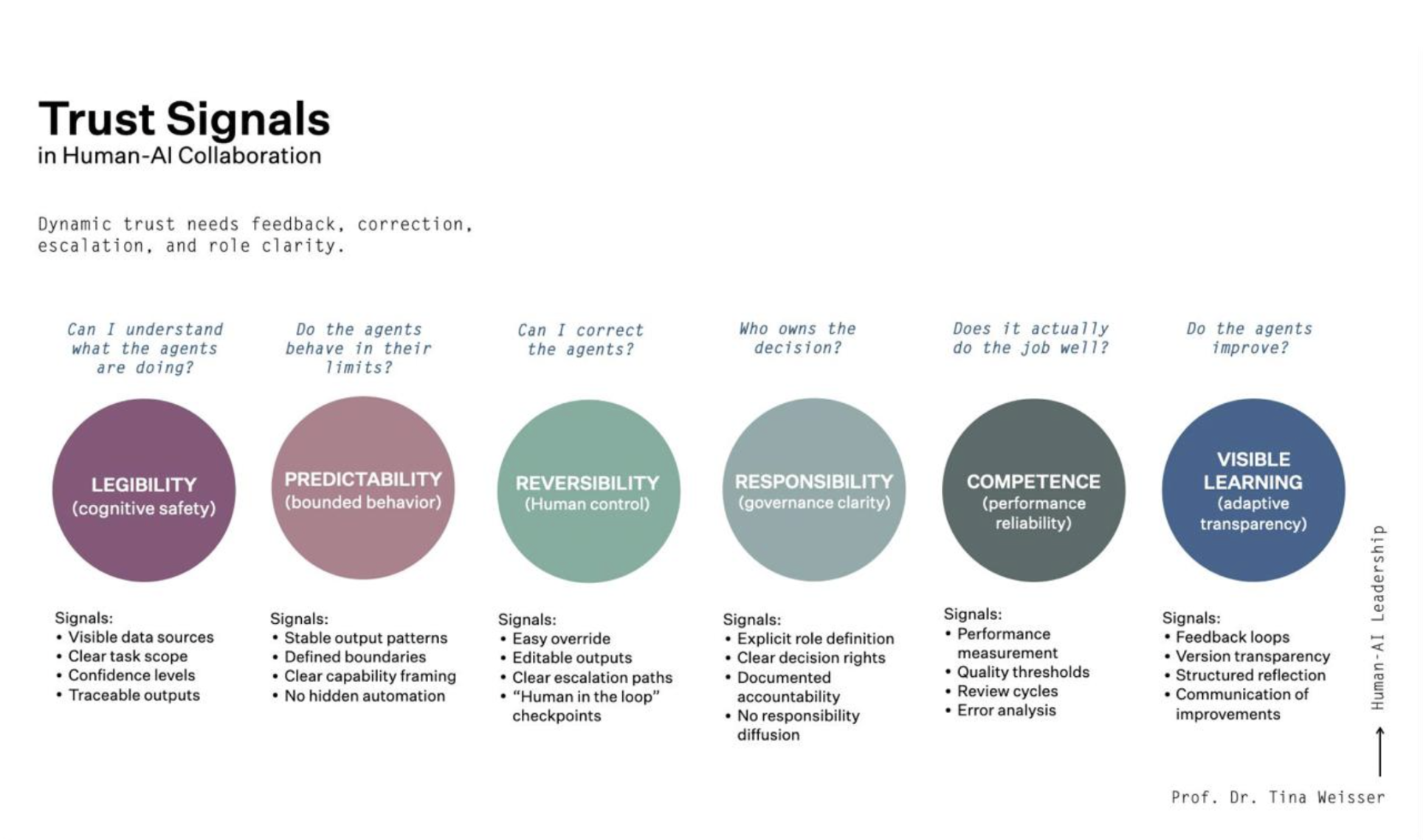
Even though AI tools exert a strong pull toward delegation, intention must take precedence over augmentation. The interface of conversational tools makes the request easy and its instantaneity makes dependence tempting. More striking still: the quality of the result makes trust natural. Yet delegating a task is not delegating learning, and competence is built through friction, through the repeated effort of going a little beyond what we already know how to do. Removing this friction saves time and, sometimes, stops progress. A study by Microsoft Research and Carnegie Mellon measures it: the more trust in the tool grows, the less critical judgment is exercised, and the work shifts from production toward verification and supervision.
From this comes a simple invitation to formulate, demanding to hold: the joy of not automating (or "JONA," the Joy Of Not Automating) that I speak of. Deliberately protecting the experiences that forge the craft and remaining master of what falls to the machine rather than the reverse. To expand rather than to augment as Marie Dollé puts it. Not the fantasy of the augmented human, but an inner opening toward others that restores breath, meaning, and presence. This boundary is sometimes ethical before it is technical: several described a use they refuse, not because it would be forbidden, but because it contradicts something they carry. The opposite risk was named in its crudest version: a skill brilliant on the surface, which empties itself from within when the doing is no longer connected to the understanding. Dorian Gray style.
Access, power, a path to invent
Behind the catch-all word "AI" hides real uses and societal questions that the expression freezes and oversimplifies. Several voices shifted the conversation toward what, at bottom, is at stake: Who controls these technologies? Who sets the rules? Who reaps the benefits?
The answer is not technical but also firmly political: spread understanding, train and open access. Ethics, in this framework, ceases to be a brake and becomes a compass that influences and orients users. The question also turns back on oneself: if my access to these tools constitutes a competitive advantage, what does this advantage say about the world taking shape, and can I make peace with it without unease?
At this scale, common norms are invented by trial and error, as once for the mobile phone. Should we entrust a model with the photograph of another person? How far do we record a conversation without breaking the attention paid to the other? A provocation crossed the table: what if professionalism, in the sense we understood it, were becoming obsolete? From this discussion emerged a shared wish: a more sensitive path, more nuanced, more conscious of the human stakes behind the technology. A first legal building block already exists: the European regulation on AI, the first comprehensive framework in the world, which entered into force in 2024 and whose main obligations apply from August 2026. But the more embodied and less brutal path that several called for remains, itself, to be written and built.
For creativity and questions
This first dinner, as experimental as it was promising, confirmed us in an intuition: the value of direct exchange. Bringing together people from different worlds makes fresh angles surface and opens a space to breathe that no tool replaces, and that also answers the isolation particular to independence. The work of Martha Beck, developed in her book Beyond Anxiety (2025), imposes itself: the opposite of anxiety is not calm; it is creativity and play.
We leave with questions rather than answers at three scales. At the scale of oneself: what do we do today with more pleasure, thanks to what we have delegated, and what spaces of slowness or presence have we chosen not to optimize? Faced with our peers: has it ever happened that we judged the use another made of AI, and what does this judgment say about ourselves? At the scale of society, finally: when did we feel the tool decide in our place, and what becomes of a singularity that is cultivated when access to the same tools becomes the norm?
Not resisting technology, nor romanticizing it, but deciding, together and consciously, what we want to preserve, cultivate, or amplify. Once singularity has been explored, whether we speak of an independent in Berlin or of every possible format of collaboration in Paris, it remains to understand how to practice with intention and discipline.